

MAV Unlimited
3D Printing at the Speed of Light.


We’ve been promised that 3D printing would change everything for about forty years now. What we got is a machine that takes five hours to print a plastic dinosaur, one excruciating layer at a time. It’s like an inkjet doing one page an hour, except every page has to be glued to the previous one. The glue between layers is exactly where printed parts break, which is why 3D printing gave us a zillion prototypes and almost no actual products. Too slow, too weak, too expensive. Factories yawned and went back to injection molding.
Researchers at Lawrence Livermore figured out something wild: you can run a CT scanner backwards. A CT scan spins around you, taking 2D slices to build a 3D picture of your insides. Volumetric manufacturing does the reverse — project the slices as light patterns into a spinning vat of photosensitive resin, and a complete object materializes in the middle. The whole thing at once. No layers. No nozzle dragging around. The part you waited five hours for prints in 3 minutes.
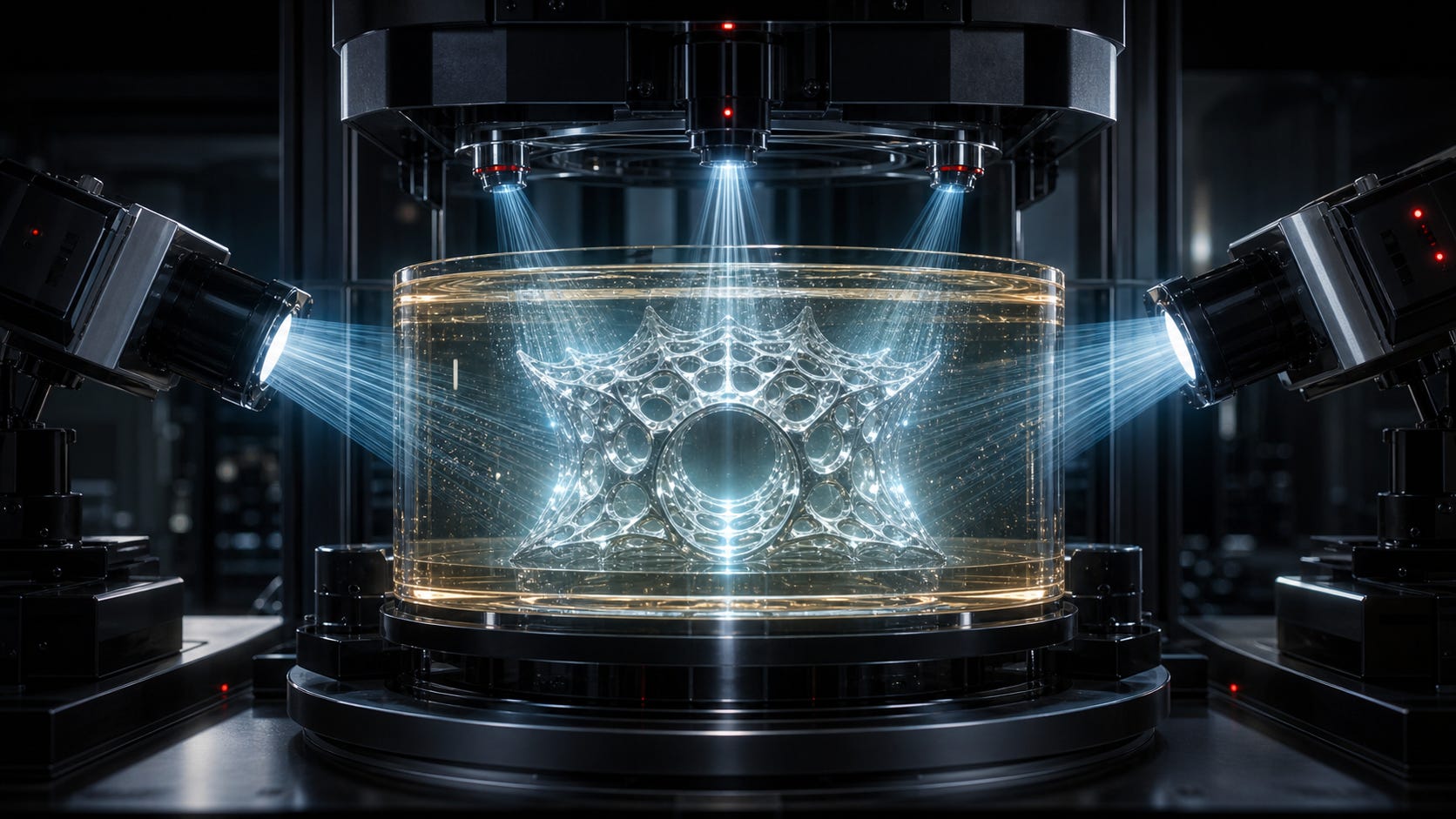
MAV Unlimited built machines that work this way to print 100x faster than the fastest commercial 3D printers, at a tenth of the cost. I cannot wait for you to see them in action. Parts just magically appear in the vat.
No layers turns out to be a superpower beyond speed. Layerless parts are stronger, since there are no seams to fail. They come out optically smooth, which means you can print lenses, prisms, and light pipes that need zero polishing. MAV can vary the hardness of the material millimeter by millimeter, printing soft and rigid zones in a single part. They’re the only additive technology that can print directly over electronics and metals — the object forms around whatever you put in the vat.
The killer app is hiding in the AI buildout. Chips increasingly talk to each other with light, and the dirty secret of photonics is that attaching the optics is the expensive part — aligning a fiber to a chip takes minutes per connection on half-million-dollar machines, eating half of the module cost. MAV prints gradient-index couplers that catch light over a wide zone, so parts can be slapped on by a regular pick-and-place robot instead of lovingly aligned by a precision instrument. The Air Force is already on board; printing custom optics and parts at a forward operating base, from locally sourced materials, is the kind of thing that makes military logistics people emotional.
This is the way manufacturing always should have worked. Light is fast. Now the printers are too.